
How Different Flooring Surfaces Impact Slip Ratings and Safety
Updated: Apr 3
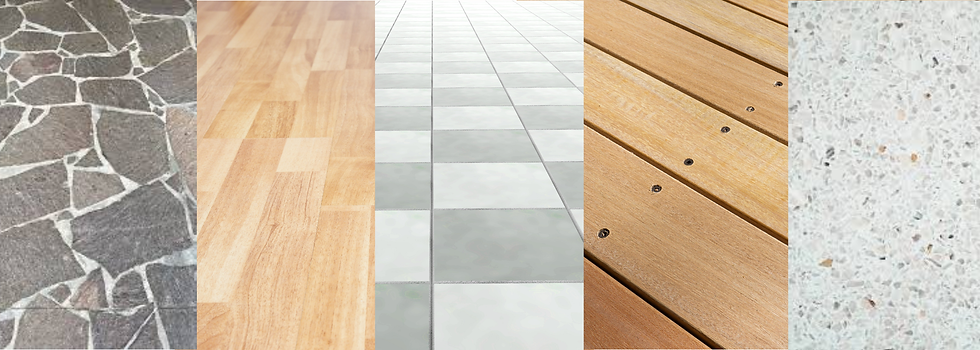
Tiles: From Porcelain to Natural Stone
Tile remains a go‑to option for high‑traffic and wet areas because it is hard‑wearing, easy to clean and available in almost any look.
Porcelain tiles are dense, low‑porosity and highly durable, making them ideal for lobbies, external entries, bathrooms and other wet areas. Textured finishes and appropriate slip‑resistance ratings are important where the surface is likely to get wet.
Terracotta tiles add warmth and character, often used in hospitality and outdoor areas. They are more porous and typically need sealing and ongoing maintenance to manage staining and moisture.
Natural stone (such as marble, granite, limestone or slate) offers a premium, timeless aesthetic. Performance varies widely between stone types, so sealing, correct cleaning regimes and slip‑resistance considerations are critical, especially in public areas.
Concrete and terrazzo tiles provide a contemporary, industrial look with excellent durability. Polished finishes can be slippery when wet, while honed or textured finishes generally perform better underfoot.
Mosaic tiles allow detailed patterns in small spaces such as bathrooms, pool surrounds and feature areas. The grout lines can add texture and grip, but design and maintenance need to be managed carefully to avoid staining and build-up.
Vinyl Flooring: Quiet, Versatile and Low Maintenance
Vinyl flooring has evolved significantly and is now common in healthcare, education, retail and residential interiors.
It is available as sheets, planks and tiles, with designs that closely mimic timber, stone and concrete while offering softer, quieter underfoot comfort.
Vinyl performs well in areas exposed to moisture and frequent cleaning, such as kitchens, amenities and back‑of‑house corridors.
It is generally resilient, easy to maintain and cost‑effective over the life of the building, provided the correct product and wear layer are specified for the expected traffic.
Substrate preparation is critical: an uneven or damp subfloor can compromise both appearance and performance.
Composite Wood Decking: Timber Look, Lower Upkeep
Composite wood (or wood‑plastic composite) decking is widely used for external terraces, podiums and balcony areas where the look of timber is desired without intensive maintenance.
Boards are typically made from a blend of wood fibres and plastics, resulting in good resistance to weathering, moisture and insect attack compared with traditional softwood decking.
They usually require less frequent finishing than natural timber, though regular cleaning is still needed to manage dirt, mould and surface film build‑up.
Surface profiles and finishes vary, and this can significantly influence slip resistance, especially in wet or shaded areas.
Composite decking can be an effective way to create usable outdoor space, provided slip resistance and maintenance are considered early in the design.
Surface Coatings, Treatments & Slip Ratings: Fine‑Tuning Performance
Surface treatments are often used to adjust the performance of an existing floor without replacing it, or to protect a new installation.
Etching and mechanical texturing can be applied to concrete and some stone surfaces to increase surface roughness and improve wet‑area slip resistance. These treatments should be carefully specified and tested to ensure they achieve the desired result without over‑roughening or making the floor difficult to clean.
Polyurethane coatings are common on concrete, timber and some existing coatings, providing chemical resistance and a protective film. They are available in matte through to high‑gloss finishes; gloss levels and system choice will influence both appearance and slip resistance.
Polyaspartic coatings cure quickly and offer high abrasion and chemical resistance, making them attractive for car parks, workshops and commercial back‑of‑house areas where downtime must be minimised. As with polyurethanes, texture and slip‑resistant additives are important in any area exposed to water, oils or contaminants.
Other specialised anti‑slip treatments, including clear anti‑slip sealers and grit systems, can be applied over tiles and concrete to improve traction in critical locations such as ramps, entries and circulation routes.


Comments